Jeffrey Karpicke is a cognitive psychologist from Purdue University. His area of research looks at strategies for long-term learning and comprehension. He published several interesting studies [1,2] in which he questioned college students on how they would study for an exam. After they had read their notes or textbook one time, they had three options to choose how they were likely to prepare.
Ever since I learned complex concepts, I noticed a trend. Whenever my grasp of the basics was solid, or I could relate the new information to already known concepts, my learning and retention were much better. I always imagined that the brain is a type of data grid where new concepts have to be linked to already present ones in order to be remembered. Perhaps that is not a perfect analogy but it does a good job to get an intuitive understanding of how we learn.
This study shows that concepts should be introduced to students in a way that they have a good grasp and familiarity with those concepts before trying to combine them into more complex informational structures. source
I’m one of those individuals who often are uncomfortable and bored in traditional educational settings. I always learned better and had more fun doing it, when reading a book. Except when I got a very enthusiastic teacher, perhaps that’s one reason why I like MOOC’s so much, they tend to be made by teachers who are highly passionate about education. Today I happened to watch some talks about learning and the brain.
I’m always getting a kick out of learning something entirely new. Perhaps that’s why I like to read about things outside of my expertise. Conceivably that preference of mine has something to do with the fact that we learn new skills in a logarithmic time curve as I learned in this TEDx talk. The logarithmic curve means that initially, we get better very fast when we learn a new skill, and then our improvement slows down gradually like observed in the graph below. 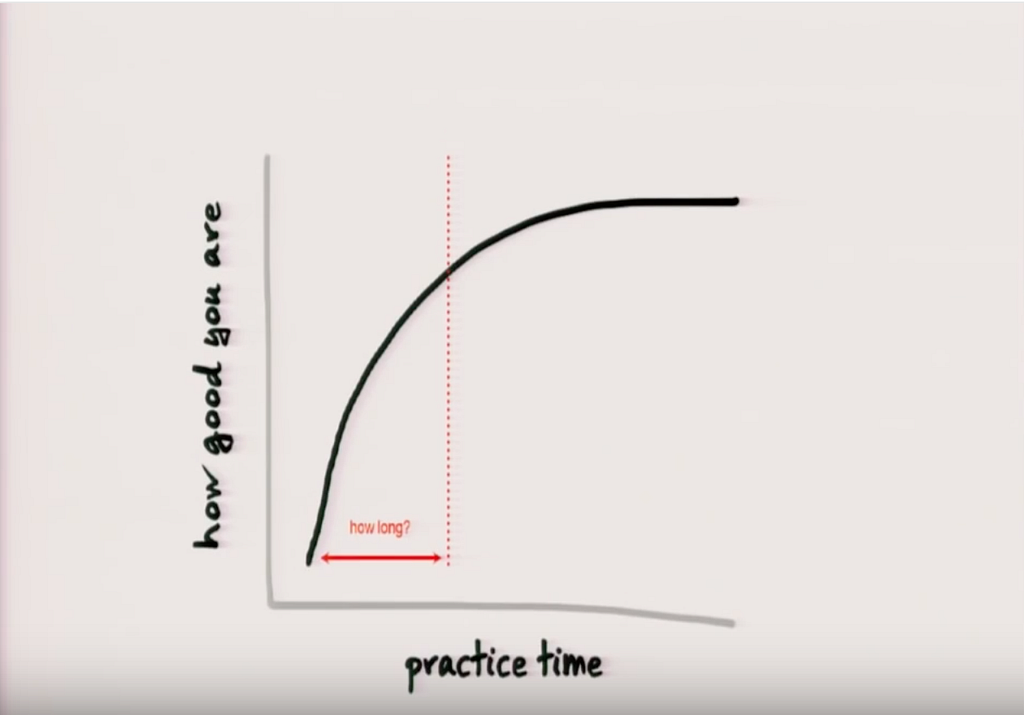 Another side effect of getting better at a task it that we take less and less time in the execution of it as seen in the performance time of this graph. Once again, the time improvement in our performance slows down logarithmically.
 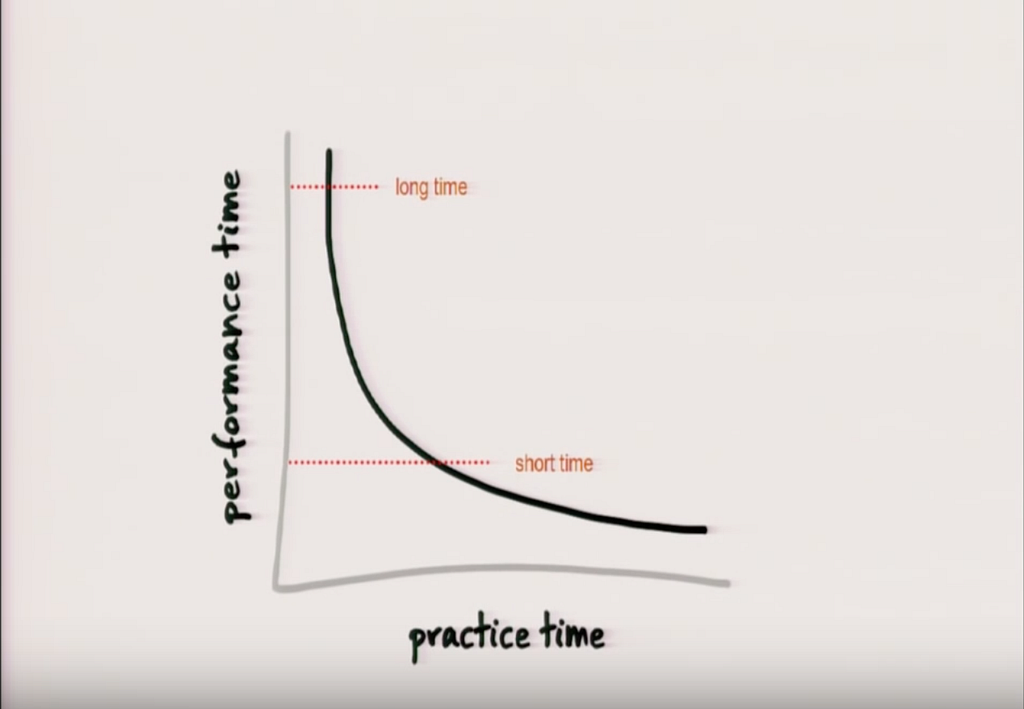 Imagine the time you could save in mastering a task you have to perform often. A carefully chosen investment of some hours of earnest practice/learning could potentially save hundreds of hours later. Summing-Up The first hours of practice when acquiring a new skill have the biggest impact because it is when our brains undergo the greatest structural changes (long term memory due to neuroplasticity). This is somewhat contrary to the notion that it is easier for you to learn new information when it is composed of concepts that you are already familiar with. See this post for more details. My interpretation of these two seemingly contradictory learning mechanics is that acquiring new knowledge has little impact once a big amount of particular expertise is already present. In other words, a person who is an expert in X can learn a new concept of X faster but compared to his/her prior knowledge, that new piece of information added just a tiny fraction to the already present knowledge in X. Originally published at karlheinzniebuhr.github.io on October 29, 2016.